Showing posts sorted by relevance for query Kappa. Sort by date Show all posts

6/19/2008

Shoochuu Liquor

[ . BACK to WORLDKIGO TOP . ]
::::::::::::::::::::::::::::::::::::::::::::::::::::::::::::::::::::::::::::::::::::::::::::::::::::

Distilled liquor (shoochuu)

***** Location: Japan
***** Season: All summer
***** Category: Humanity


*****************************
Explanation

shoochuu 焼酎 (しょうちゅう)
shochu, strong distilled liquor
Schnaps

awamori 泡盛(あわもり)from Okinawa
. . . CLICK here for Photos !

kasutori shoochuu 粕取焼酎(かすとりしょうちゅう)
. . . CLICK here for Photos !

imojoochuu 甘藷焼酎, 芋焼酎 (いもじょうちゅう)from sweet potatos
. . . CLICK here for Photos !
Kartoffelschnaps

kibijoochuu 黍焼酎, きび焼酎(きびじょうちゅう)from kibi millet
. . . CLICK here for Photos !
Hirseschnaps


CLICK for more photos


:::::::::::::::::::::::::::::::::::::::::::::::::::::::::::::::::::::::::::::::::::::::::::::::::::


Shōchū is an alcoholic beverage of Japan, most commonly distilled from barley, sweet potato or rice. Typically it is 25% alcohol by volume, making it weaker than whisky, but stronger than wine and sake.
Shōchū is produced everywhere in Japan, yet the home of shochu is Kyūshū island.
Shōchū should not be confused with sake, a brewed rice wine. Its taste is usually far less fruity and depends strongly on the nature of the starch used in the distilling process. Its flavour is often described as "nutty" or "earthy".

History
The exact origin of shōchū is unclear. Originally alcohol the strength of shōchū was called araki (arak) or rambiki (alembic) in Japan; arak is a generic term for a variety of distilled alcoholic drinks throughout the Middle East. Shōchū likely first arrived either in Kyūshū through Thailand and Ryukyu (Okinawa) or in Iki Island from Korea which adopted it from the Mongols who themselves acquired the distillation process from Persia.

As far as can be determined from Japanese historical record, shōchū appears to have been made since at least as far back as the 16th century. For example, when the missionary Francis Xavier visited Kagoshima Prefecture in 1549, he recorded that
"the Japanese drink arak made from rice [...] but I have not seen a single drunkard. That is because once inebriated they immediately lie down and go to sleep."

Further, at Kōriyama Hachiman shrine in Ōkuchi, Kagoshima, the oldest existing direct reference to shōchū in Japan can be found. There, two carpenters working on the shrine in 1559 inscribed the following graffiti on a wooden plank in the roof:
"The high priest was so stingy he never once gave us shōchū to drink. What a nuisance!"


honkaku shōchū
moromitori shōchū
黒糖焼酎,lurotoo joochuu kokutōjōchū from brown sugar
そば焼酎, sobajoochuu, from buckwheat

kasutori shōchū (粕取り焼酎 is made by distilling the sake lees left over from the fermentation of sake.
Seichō kasutori shōchū (正調粕取焼酎)

hashira shōchū (柱焼酎)
sanaburi shōchū (早苗響, sanaburi)

(混和焼酎, konwashōchū)
© More in the WIKIPEDIA !

:::::::::::::::::::::::::::::::::::::::::::::::::::::::::::::::::::::::::::::::::::::::::::::::::::::


A lot of shochu is brewed in Kyushu.
Sweet potato liquor is most famous from Kagoshima, second from Miyazaki.

Shochu from Miyazaki
The alcohol content is only about 20%, since this was cheaper to sell right after the second world war. Now this gentle liquor is a favorite of ladies.
In the southern parts near Kagoshima, there is sweet potato liquor.
In the central parts, both sweet potato and rice liquor.
In the western parts near Kumamoto, rice liquor.
In parts near Oita, liquor is made from soba buckwheat, mugi wheat, toomorokoshi corn or kibi millet.
CLICK for more photos
Liquor from Miyazaki comes in glass bottles or ceramic bottles, a favorite souvenier of the prefecture.

.......................................................................


:::::::::::::::::::::::::::::::::::::::::::::::::::::::::::::::::::::::::::::::::::::::::::::::::::::


CLICK for more Daruma shochu photos


CLICK for the Daruma Museum Shochu site
Daruma Shochu


*****************************
Worldwide use


*****************************
Things found on the way


CLICK for more photos !

. 九千坊河童 Kyusenbo kappa - Kusenbo Kappa .
from - Tanushimaru 田主丸 Fukuoka, Kyushu


Schnaps with the Water Goblin, Kappa san
- KAPPA - 河童 / 合羽 / かっぱ / カッパ - ABC-Index -


*****************************
HAIKU


焼酎の味を守るや女たち
shoochuu no aji o mamoru ya onnatachi

they keep the taste
of sweet potato liquor ...
these women brewers


For the female shochu brewers of Nichiman Village in Miyazaki, Kyushu.
In the third generation, the ladies keep the secret of the family brew.
Together with other women from the town they have developed some soft liquor for ladies, called NAOYAKA NARI
The earthen containers are more than 120 years old and not produced any more. The brewers have to be very careful when blending the ingredients with a bamboo pole not to break a pot, since only 50 are left.
日南焼酎, 古澤醸造
宮崎県日南市材木町6-12

Gabi Greve, December 2008


嫋なり【たおやかなり】Naoyaka Nari


:::::::::::::::::::::::::::::::::::::::::::::::::::::::::::::::::::::::::::::::::::::::::::::::::::::


A shochu from Miyasaki prefecture,
called KIGO.

The name is taken from the season word for haiku
俳句における季語(KIGO)

made from sweet potatoes, a mix of three different kinds of original schnaps.

The mix originated in the year 1834, when an English taster テイスター experimented with the liquor.
For additional "hidden" flavor, a bit of grated mikan peel, cinnamon, blossom fragrance, dried grapes and others are added.

You can enjoy this taste in all the four seasons!

source : sakashodouraku

.................................................................................


. from friends on facebook :

kigo -
a summer drink
for all seasons


Hortensia Anderson

. . . . .


We have a bottle
of Kigo and share
our haiku


Angelika Bygott

. . . . .


Kigo's scent
never fades while reading
Santoka,s verses


Massih Talebian


"Taneda Santoka(1882-1940) was very poor and he used to drink SHOCHU beacuse it is cheaper than SAKE but feels AWFUL the next day. In October 1930 Santoka has drunk a lot of Shochu and therefore he couldn,t leave the bed in the morning and he writes this haiku:

chill chill of the earth
I give up
my feverish body to it"


. Santoka and Sake 種田山頭火

.................................................................................


morning moon
Kigo still lingers
on his breath


Chen-ou Liu

.................................................................................


shoochuu
the slurring voice
of a kigo


Don, SH


出羽鶴 本格焼酎 - なまはげ Namahage Shochu Liquor

. Namahage なまはげ Demons of Akita .

*****************************
Related words

SUMMER DRINKS


***** DRINKS SAIJIKI

:::::::::::::::::::::::::::::::::::::::::::::::::::::::::::::::::::::::::::::::::::::::::::::::::::::::::::::::::::::::::::

. Legends and Tales from Japan 伝説 - Introduction .

- reference : nichibun yokai database 妖怪データベース -
14 legends to explore

:::::::::::::::::::::::::::::::::::::::::::::::::::::::::::::::::::::::::::::::::::::::::::::::::::::::::::::::::::::::::::

[ . BACK to DARUMA MUSEUM TOP . ]
[ . BACK to WORLDKIGO . TOP . ]

:::::::::::::::::::::::::::::::::::::::::::::::::::::::::::::::::::::::::::::::::::::::::::::::::::::::::::::::::::::::::::

4/19/2008

Senbei Arare

[ . BACK to WORLDKIGO TOP . ]
::::::::::::::::::::::::::::::::::::::::::::::::::::::::::::::::::::::::::::::::::::::::::::::::::::

rice crackers (senbei 煎餅)

***** Location: Japan
***** Season: Topic
***** Category: Humanity


*****************************Explanation

CLICK for more Japanese photos CLICK for more English Information

There are many specialities with the name ... senbei.
Some are made from rice flour, some from mochigome rice flour and others from wheat flour.

age senbei 揚げせんべい deep-fried crackers
chibimaru senbei ちび丸せんべい, for Chibi Mariko Manga
ebisenbei, ebisen えびせんべい with shrimp
goma senbei 胡椒せんべい with sesame seeds
haatogata senbei ハート型せんべい shape of a heart
oshiage senbei 押上せんべい
shoyu senbei with soy sauce 醤油せんべい (しょうゆせんべい)
shio senbei with salt 塩せんべい
tai senbei 鯛せんべい with sea bream
teyaki senbei 手焼きせんべい handmade senbei

ebisenbei from shiba-ebi, Aichi prefecture

::::::::::::::::::::::::::::::::::::::::::::::::::::::::::::::::::::::::::::::::::::::::::::::::::::

- - - - - other types are made from glutinous rice:
arare あられ
okaki おかき (御欠き)
kakimochi 欠き餅(もち)

quote
Arare (あられ "hailstones") is a type of bite-sized Japanese cracker made from glutinous rice and flavored with soy sauce. The size and shapes are what distinguish arare from senbei.
CLICK for more photos There are many different sizes, colors, and shapes of arare. Some are sweet, and others savory. One, called norimaki arare (nori meaning an edible seaweed foodstuff in the form of a dried sheet; maki meaning roll shape) is wrapped with dried nori seaweed. Another, kakinotane (柿の種, kakinotane), takes its name from its resemblance to a persimmon seed. (Kaki is Japanese for "persimmon".) Kakinotane are often sold with peanuts, a combination called kakipī (かきピー, kakipī. These are a popular snack to accompany Japanese beer.

Japanese typically consume arare to celebrate the Doll Festival (Hinamatsuri), on March 3, Girls' Day in Japan. The arare made during the festival are very colorful - pink, yellow, white, brown, light green, and so on. Regular arare can be bought throughout the year, but the colorful ones are only available around January to March in anticipation of the Doll Festival.
© More in the WIKIPEDIA !


. arare ochazuke あられお茶漬 Arare with green tea
from Mie prefecture


- - - - - My Photo Album - - - - -
Senbei


:::::::::::::::::::::::::::::::::::::::::::::::::::::::::::::::::::::::::::::::::::::::::::::::::::

Senbei (irimochi) (煎餅, せんべい)
are Japanese crackers, made from nonglutinous rice. They come in various shapes, sizes, and flavors, usually savory but sometimes sweet. Senbei are often eaten with green tea as a casual snack and offered to visiting house guests as a courtesy refreshment.

Senbei are usually cooked by being baked or grilled, traditionally over charcoal. While being prepared they may be brushed with a flavoring sauce, often one made of shoyu and mirin. They may then be wrapped with a layer of nori. Alternatively they may be flavored with salt or so-called "salad" flavoring.

In China, senbei are called jiānbang (煎餅). There are varieties like Shandong Jianbing and Tianjin Jianbing. However, these are in actuality a different food. In China, they are more like wraps and pancakes, similar to okonomiyaki, whereas in Japan they are hard (not floppy), and are bite-sized snacks rather than meals.

Sweet senbei (甘味煎餅) came to Japan during the Tang dynasty, the first recorded usage in 737 AD, and still are very similar to Tang traditional styles, originally often baked in the Kansai area, of which include the traditional "roof tile" senbei. These include ingredients like potato and wheat flour or glutinous rice, and are similar to castella cakes. (Not like what people most think of senbei today).

What Japanese commonly refer to as sembei nowadays was popularized by a shop in the Edo Period, Sōkajuku, which spread salty soy sauce flavored sembei throughout Japan.
- Soka Senbei, see below -

There are several types of traditional Japanese senbei. They include the 2 categories, sweet sembei (over 15 types) and rice candy senbei (米菓煎餅),
and others, which include even fish senbei (魚せんべい), lotus senbei (蓮根煎餅) and bone senbei (骨せんべい) from fish bones.

Modern senbei versions are very inventive and may include flavorings can which range from kimchi to wasabi to curry to chocolate.

Kansai senbei tend to use glutinous rice and have a lightly seasoned and delicate in texture (saku saku). Kantō senbei were originally based on uruchimai, a non-glutinous rice, and they tend to be more crunchy (kari kari) and richly flavored.
© More in the WIKIPEDIA !


. Food vendors in Edo .

senbeiya, senbei-ya 煎餅屋 Sembei shop, Senbei shop
Senbei were very popular in Edo and sold at many shops.

Danjuroo senbei 団十郎煎餅
named after the popular Kabuki actor Ichikawa Danjuro were especially popular. They were round and imprinted with the family crest of the Danjuro family, the 三升 Mimasu.

Asagao Senbei 朝顔煎餅 / 朝顔せんべい morning glory rice crackers
were mentioned in the Kabuki play
. Sukeroku yukari no Edo-zakura 助六由縁江戸桜 .
The funny clown actor was named 朝顔仙平 Asagao Senbei. The painting of the actor's face was related to various parts of a morning glory.


source : kabuki-za.com/syoku

The play has a long monologue about the various uses on senbei.
senbei zukushi せんべい尽くし

「事もおろかやこの糸びんは砂糖煎餅が孫、羽衣せんべえはおれが姉様、
双六(すごろく)せんべえとは行逢(ゆきあ)い兄弟、姿見煎餅はおらがいとこ、
竹村の堅巻せんべえが親分に、
朝顔仙平という色奴(いろやっこ)様だ」

They were sold by Fujiya Seizaemon.
- reference source : tukitodora.exblog.jp -

and modern Kabuki Senbei 歌舞伎せんべい


:::::::::::::::::::::::::::::::::::::::::::::::::::::::::::::::::::::::::::::::::::::::::::::::::::

. Kokeshi Senbei こけし せんべい .

:::::::::::::::::::::::::::::::::::::::::::::::::::::::::::::::::::::::::::::::::::::::::::::::::::


Darums Senbei from Maebashi だるま煎餅 
前橋の丸福本舗

Gunma Prefecture


七転び八起き
Nanakorobi yaoki
seven times down, eight times up
- - - Daruma Lore

八起せんべい Yaoki Senbei


:::::::::::::::::::::::::::::::::::::::::::::::::::::::::::::::::::::::::::::::::::::::::::::::::::


Asakusa Iriyama Senbei shop 入山せんべい


- reference source : shinise.tv/iriyamasenbei... -


:::::::::::::::::::::::::::::::::::::::::::::::::::::::::::::::::::::::::::::::::::::::::::::::::::


Edo Daruma Hakkei 江戸だるま八景
Eight views of Daruma in Edo


Eight different flavors of Daruma Senbei!
だるまの形をした8種類のおせんべい。Nihonbashi Nishiki Horin
- reference source : 日本橋錦豊琳 -


. Hokusai, Great Wave and Tsunami
北斎 津波  .


:::::::::::::::::::::::::::::::::::::::::::::::::::::::::::::::::::::::::::::::::::::::::::::::::::

Fish bones roasted "like senbei",
hone senbei 骨せんべい


If you grill fish at home, you can grill the big bones in a final round to produce your own. They are full of calcium and good for children and the elderly. They are sold as a snack.

CLICK for more photos
Knochen-Kräcker

:::::::::::::::::::::::::::::::::::::::::::::::::::::::::::::::::::::::::::::::::::::::::::::::::::

Ebisenbei from Hokkaido えびせんべい
ebisen えびせん


source :  store.shopping.yahoo.co.jp

かにせん kanisen with crabmeat
わかめせんwakamesen with wakame seaweed
うにせん unisen with sea urchins

えびせんべい・抹茶 ebisenbei macha .. shrimps with green tea
えびせんべい・かぼちゃebisenbei kabocha shrimps .. with pumpkin
えびせんべい・いかすみえびせんebisenbei ikasumi ... with ink from the squidえびせんべい・えびせんべい・わさびせん kawaebi ... with river shrimp

and many more !

Buson-An and Sakura-Ebisen 蕪村菴 さくらえびせんべい


Darume Ebiesn だるま海老せん
桂新堂


「和物」プリントえびせんべい福だるま

.......................................................................

Kappa Ebisen かっぱえびせん


- quote -
Kappa Ebisen (かっぱえびせん) is a Japanese snack food produced by Calbee of Japan in Hatsukaichi, Hiroshima. It is a crunchy, shrimp-flavored snack resembling Krupuk, Indonesian traditional snack food and It became very popular in Japan. The version produced by Calbee America is called Shrimp Flavored Chips.
The primary ingredients of Kappa Ebisen are wheat flour, vegetable oil, starch, shrimp, sugar, salt, baking powder, amino acid and sweetening.
Kappa Ebisen was first produced and sold by Calbee in 1964 and has gained wide popularity among Japanese consumers as a snack food. Its simplicity makes it a popular snack in many settings, and is often a popular choice for karaoke or as a bar snack. ...
- - - More in the WIKIPEDIA !


:::::::::::::::::::::::::::::::::::::::::::::::::::::::::::::::::::::::::::::::::::::::::::::::::::

. Ichiyo Senbei 一葉煎餅(いちようせんべい)  
In honor of the poetess Higuchi Ichiyo 樋口 一葉

. Ishida Mitsunari 石田三成 せんべい
In honor of the famous samurai
 

.................................................................................


Jibachi senbei 地蜂煎餅, 地蜂せんべい
Wasp rice crackers


CLICK for more

In Omachi, 120 miles northwest of Tokyo, there is a fan club Omachi Jibachi Aikokai (Omachi digger wasps lovers group) that has teamed up with a local biscuit maker to create jibachi senbei, or digger wasp rice crackers.
Elderly wasp hunters from the village, who are mostly in their 80s, catch the insects in nearby forests, boil them in water, dry and sprinkle them over the cracker mix, which is then stamped by hot iron cracker cutters.
Five or six black digger wasps are added to the rice cracker each, clearly visible to the naked eye and while the senior citizens love them, young Japanese see the bugs and refuse to eat the senbei!
source :  japansugoi.com

Sold in a bag with 20 pieces.

More about
Konchu Ryori, konchuu ryoori 昆虫料理 Insects as food


:::::::::::::::::::::::::::::::::::::::::::::::::::::::::::::::::::::::::::::::::::::::::::::::::::

- - - - - 18 types of senbei - - - - -

CLICK for enlargement to read
Imaya Senbei Store, Kanazawa 今屋のおせんべい 


burandii senbei, burandei senbei ブランデーせんべい / ブランデー煎餅
senbei with brandy flavor
. . . CLICK here for Photos !
from Tsukui Senbei Shop 津久井せんべい本舗
They even got an official prize 内閣総理大臣賞受賞.
They are normal senbei covered with a layer of flour mixed with real French brandy.
The owner was inspired by whiskey bonbons and tried his family trade, senbei, with various flavors. Now they create 30 different ones for example
koohii senbei 珈琲煎餅 senbei with coffee flavor
wain senbei ワインせんべい wine flavor senbei


There are also wine senbei in memory of Takeda Shingen from Yamanashi.
武田信玄のワインセンベイ
CLICK for more photos

:::::::::::::::::::::::::::::::::::::::::::::::::::::::::::::::::::::::::::::::::::::::::::::::::::::

karee senbei カレーのおせんべい sembei with curry flavor
. . . CLICK here for Photos !


kootsuu anzen senbei 交通安全せんべい
senbei used in campaigns for safe driving


. Masakado Senbei 将門煎餅 .
for Taira no Masakado 平将門 / 平將門 (? – 940)

::::::::::::::::::::::::::::::::::::::::::::::::::::::::::::::::::::::::::::::::::::::::::::::::::::

Nanbu senbei, Nambu senbei 南部せんべい
from Morioka, former Nambu province

Nambu Sembei, waffles from Nanbu
Made from wheat flour, salt and water. The dough is pressed into round waffle molds with long handles and baked over charcoals. The overflowing baked dough is cut off and also sold as "ears" mimi to put into soup.
They come in variuos flavors. Originated in Hachinohe, where there are many local brands in the shelves of the supermarkets.
. . . CLICK here for Photos !

senbeijiru せんべい汁 senbei soup
Make soup with vegetables, mushrooms and meat and add Nanbu senbei just before eating.
There is a special senbei brand which does not dissolve in hot water.

CLICK for more photos


senbei aisu せんべいアイス Senbei filled with ice cream !


- - - - - Nambu-Waffeln
Die berühmten Nambu-Waffeln kommen aus der Stadt Hachinohe, die in der heutigen Präfektur Aomori liegt, einst die Domäne Nambu. Früher dienten die Waffeln als haltbare Nahrungsmittel für die langen Wintermonate.

In den Supermärkten von Hachinohe finden sich endlose Regale mit über 40 Sembei-Sorten, allein zehn davon mit Sesam. Meistens werden sie in kleinen Familienbetrieben von Hand gebacken, sodass jede Sorte ihren einzigartigen Geschmack erhält.

Bei ganz einfachen Waffeln besteht der Teig lediglich aus Weizenmehl, Salz und Wasser. Die Sembei werden in Waffeleisen mit langen Griffen über glühenden Holzkohlen oder in einem elektrischen Heizgerät gebacken. Die Temperatur für Waffeln ohne Füllung sollte 130 °C betragen. Der Bäcker muss darauf achten, sie ständig zu wenden, damit sie nicht anbrennen. Mittlerweile wurden auch spezielle Maschinen zur Waffel-Herstellung entwickelt, die in Kleinbetrieben bis zu 3000 Waffeln täglich backen können. Die Bäcker allerdings müssen stets wachsam sein, da gleichzeitig Teig in die Formen gegossen und Waffeln aus den Formen herausgenommen werden mussen.


Zur Geschmacksverfeinerung wird häufig schwarzer Sesam mitgebacken, der den Waffeln einen unverwechselbar aromatischen Geschmack gibt. Einige Hersteller bestellen das unverzichtbare Salz für den Teig sogar aus den Hochebenen von Tibet, weil dieses Natursalz dank seines Mineralgehaltes dem Gebäck überraschenderweise eine gewisse natürliche Süße verleiht.

Für andere Sorten werden klein gehackte Erdnüsse mit etwas Zucker eingebacken. Andere Mischungen ergeben sich aus Äpfeln und Kürbissen, Süßkartoffeln und Shiso-Blättern. Auch verschiedene Getreidesorten werden beigemischt. Für einen herzhafteren Geschmack kommen Zwiebeln, Sojasauce, Chili, Tintenfisch oder Jakobsmuscheln mit in den Teig.

Der bei der Herstellung am Rand herausquellende Teig wird nicht entfernt, sondern mitgebacken, und in Körben gesammelt. Viele Kunden lieben diese von den Japanern »Ohren« genannten Reststücke als Zutat für die tägliche Suppe. Sie kommen daher auch in den Verkauf. Ebenfalls als Suppenzutat, und zwar für Eintöpfe im Winter Senbeijiru, werden weiße Sembei gebacken. Sie sind sehr hart und lösen sich im heißen Wasser nur langsam auf. Weitere Zutaten dieses Eintopfs sind Hühnerfleisch, Wintergemüse, Pilze – und alles, was der Familie schmeckt.

:::::::::::::::::::::::::::::::::::::::::::::::::::::::::::::::::::::::::::::::::::::::::::::::::::::


ninniku agesenbei ニンニク揚げせんべい
fried senbei with garlic


from Northern Japan, Fukushima
also with cheese flavor

:::::::::::::::::::::::::::::::::::::::::::::::::::::::::::::::::::::::::::::::::::::::::::::::::::::

Soka senbei, Sooka senbei 草加せんべい
Soka (Sooka), Saitama, a famous senbei city
埼玉県草加市
CLICK for more photos

A Senbei (Rice Cracker) is the traditional confectionery of Soka. There are, however, many people make a mistake that it is Tokyo's specialty product. For this reason, we would like to let you have a correct understanding that how our local special product "Senbei" has been made and has become famous in all over Japan. Also, in February 2006, Soka Senbei was specified as " regional food brand (the genuine product made at the genuine place)", and in June 2007, it was registered as "regional organization trademark". For such the situation, Soka Senbei has been recognized as the brand name nevertheless there are many similar products being manufactured and sold. Here, we would consider how we should make more popular the brand name value of the real genuine "Soka Senbei"

Origin of Soka Senbei
When Town Soka was busy as the post town point on Nikko Kaido (Nikko Highway leading to Nikko) during the era of Edo, Ms "Osen-san" was selling dumpling cakes. One day, under suggestion from a passerby "samurai", she made a sort of Senbei in the shape of a baked rice cracker by crashing dumpling cake to flat and keeping it dry under the sun heat. It has been told that she, then, began making and selling it.

History of Soka Senbei
With regard to the history of our special product "Soka Senbei", we would herein introduce how it has finally become popular all over Japan as follows.
Hard Baked Rice Crackers were changed to Flat Salty Senbei during the era of Edo.

The Soka region was the typical village for cultivation of rice and in order to store surplus rice, people made Senbei, initially called Kata-Mochi (Hard Rice Cake).
When the Soka Post Town was set up during the era of Edo, there were many teahouses and food shops along with Nikko Kaido Road and this preservative food were being sold to travelers, which finally became very popular. At the early stage, salt was mixed into the Senbei rice cracker, but after the end of Edo era, it changed to put soybean sauce (shoyu) on a flat shaped Senbei after baking. At the beginning, some shops were called Salt Senbei Shops.

Turning Point was when the Senbei was presented to the Emperor
-- Eras of Meiji to Taisho

From the later of Meiji era, Soka Senbei shops had been gradually increased but many of them handled the Senbei as the side job in addition to sell other general merchandizes.
At the time of Taisho (after the era of Meiji), the Japanese army had a comprehensive military practice in Kawagoe and Soka Senbei was presented to Emperor Taisho, who was, then, the general commander of the Japanese army. This fact became the good turning point to expand the Senbei business.
The Soka Senbei was specified and expanded to all over Japan because "the emperor family purchased the delicious senbei". The local Soka Senbei Industry has been established, which was further expanded around that time and begun to enjoy making the product as the Soka's specialty product. It, then, continued making a prosperous progress for expansion.

Time of Sufferings, Glory and Fog
-- From Eras of Showa to Heisei
The Soka Senbei industry had made a good progress when entered to the era of Showa. However, during the Second World War, it had become very difficult time to obtain the material - i.e., rice - due to the severe control by the government on rice, so that many Soka Senbei Manufacturers (shops) had to discontinue the business one by one. Some of them, however, continued business obtaining the rice material somehow under the severe control by the authority (police). That time was the most difficult time for the Soka Senbei industry.

But only the good thing was Soka Senbei Manufactures maintained the manufacturing method (technique) under the dangerous situation (by police and military group). This was very good and lucky because the police authority is controlling rice distribution at the black market very severely, but some shops obtained the material (rice) somehow. Under such situation, the industry kept the traditional technique to make the Senbei, which is now greatly contributed for the industry and the market.

During the time of 1960s, the rice control was discontinued and the industry could follow the way of the high degree economic growth as the same as other main industries. Again, the name of Soka Senbei had been well known through special sales campaigns at department stores and big railway station's shopping areas.

However, in a proportion to rising of the well-known product name as "Soka Senbei", Senbei makers of other regions had begun making similar products even under different production methods. They began selling under the name of Soka Senbei at many places in Japan nevertheless the quality and taste were not good as the genuine Soka Senbei. As the result, although the name of "Soka Senbei" could obtain the good popularity, its reliability was deteriorated and the definition of "Soka Senbei" could badly become vaguely. The tendency has been continued to today.
source :  www.city.soka.saitama.jp

:::::::::::::::::::::::::::::::::::::::::::::::::::::::::::::::::::::::::::::::::::::::::::::::::::::


Takabe Jinja Senbei 高家(たかべ)神社煎餅
In honor of the God of Cooking,
God of Iwakamutsukari no Mikoto 磐鹿六雁命


. Tokyo Sky Tree Senbei 東京スカイツリー .
May 22, 2012 - Grand Opening

:::::::::::::::::::::::::::::::::::::::::::::::::::::::::::::::::::::::::::::::::::::::::::::::::::::

Unzen yusenpei ゆせんぺい senbei from hot spring water
Nagasaki, Mount Unzen

. Urashima Taro 浦島太郎 Ebisen えびせんべい .

:::::::::::::::::::::::::::::::::::::::::::::::::::::::::::::::::::::::::::::::::::::::::::::::::::::

CLICK for more photos

Lucky Waffles with Toys inside, fukutoku senbei 福徳せんべい

::::::::::::::::::::::::::::::::::::::::::::::::::::::::::::::::::::::::::::::::::::::::::::::::::::

Yaotsu Senbei 八百津町 せんべい
From Yaotsu Town, Gifu.
They produce about 100 different kinds of senbei with many flavors.
The latest is a huge one of 1 meter diameter, made for events to share with the kids.
sauce yakisoba senbei ソース焼きそばせんべい is loved by younger people.
Senbei as containers of local ice cream, eaten with a senbei formed like a spoon.

. . . CLICK here for Photos !


*****************************
Worldwide use

Reiskräcker, Waffeln, Nanbu-Waffeln
Gebäck

*****************************
Things found on the way


- - - Naschen erlaubt: Sembei
Unter Sembei fasst man in Japan verschiedene Gebäck-, Waffel-, und Kräckersorten zusammen, die entweder aus Reismehl, Mochigome-Klebreismehl oder Weizenmehl gebacken und flach gepresst sind. Sie können süßlich oder salzig schmecken. Eine Sembei-Dose ist in jedem japanischen Haushalt zu finden, denn Sembei bilden das Mindestmaß an Gastfreundschaft. Kommen Gäste ins Haus, wird als erstes grüner Tee gekocht, gleich darauf werden Sembei aus der Dose genommen, auf einem Servierteller angerichtet und vor die Gäste auf den niedrigen Tisch gestellt. Der grüne Tee folgt unverzüglich. Sembei sind nicht nur für Gäste ein beliebter Snack, sondern auch für die ganze Familie. Sie werden zu jeder Tageszeit gegessen.

Das Gebäck gibt es in unzähligen Geschmacksrichtungen mit Sojasauce oder anderen Zutaten gewürzt. Sie sind rund oder viereckig, sternförmig oder wie ein Dachziegel geformt. Am beliebtesten ist die flache, runde Sembei-Sorte aus einfachem Reismehl mit dem Geschmack von Sojasauce. Sie verbreitete sich ab dem 17. Jahrhundert von Edo (heute Tokyo) aus über ganz Japan. Diese Sembei sind besonders knusprig und werden durch weitere Zutaten im Geschmack variiert.

In vielen Städten mit Sehenswürdigkeiten gibt es Geschäfte, die gleich am Ortseingang oder Bahnhof frische Sembei herstellen und einzeln verkaufen. Der verlockende Röstduft zieht die Kunden schon von weitem an, die hier Reisemitbringsel (meibutsu) aus der Gegend erstehen können. In Japan ist es üblich, von einer Reise etwas für die Daheimgebliebenen, insbesondere Arbeitskollegen, mitzubringen. Sehr gern werden Sembei, die zusammen in der Pause genascht werden können, nach einem Urlaub verschenkt.

*****************************
HAIKU


煎餅をいぬがかむ音花の雨
senbei o inu ga kamu oto hana no ame

the sound of senbei
when my dog crunches them...
rain on the cherry blossoms


Hoshino Tatsuko 星野立子
Tr. Gabi Greve

:::::::::::::::::::::::::::::::::::::::::::::::::::::::::::::::::::::::::::::::::::::::::::::::::::::


long autumn rain -
the smell of senbei and
smoked cheese


These senbei, rice crackers, have a very typical smell. They are called mame mochi with roasted soybeans, from Tokachi, Hokkaido. Each one is wrapped in an extra pouch and when you open one, the rich fragrance of rice emerges from it.

Gabi Greve, September 2009


*****************************
Related words

***** WASHOKU : General Information

::::::::::::::::::::::::::::::::::::::::::::::::::::

[ . BACK to DARUMA MUSEUM TOP . ]
[ . BACK to WORLDKIGO . TOP . ]
- #senbei #sembei #ricecrackers #kappaebisen #ebisen -
:::::::::::::::::::::::::::::::::::::::::::::::::::::::::::::::::::::::::::::::::::::::::::::::::::::::::::::::::::::::::::

4/01/2008

Ameyoko Kappabashi Ueno

[ . BACK to WORLDKIGO TOP . ]
. 河童 The Kappapedia .
::::::::::::::::::::::::::::::::::::::::::::::::::::::::::::::::::::::::::::::::::::::::::::::::::::

Ameyoko Street in Ueno

***** Location: Japan
***** Season:
***** Category: Humanity


*****************************
Explanation

Ameyoko あめよこ (アメ横) is a famous shopping street running from Ueno station to Okachimachi in Tokyo.
Ameyoko street market.Ameyoko shopping alley.

It is a MUST for the shopping for New Years items, everything is cheap ...
After WWII it was a place for smuggled itmes, and also a famous sweet shop, ameya 飴屋 was in the area. AME also was an abbreviation for AMERICA in these days.

There is also a lot of other discounted stuff there. There is second-hand fashion, super bargains and a lot of candy! It is a heaven for bargain shoppers.

CLICK for more photos

Officially the name is Ameya Yokocho, ameya yokochoo アメ屋横丁.
yokochoo is the normal name for a small alley.

CLICK for more English information !


Ameyokoyaki アメ横焼き Ameyoko-style pancake
. . . CLICK here for Photos !


:::::::::::::::::::::::::::::::::::::::::::::::::::::::::::::::::::::::::::::::::::::::::::::::::::

Close to Ameyoko is the famous

Asakusa KAPPABASHI 東京都 かっぱばし/ かっぱ河 / 合羽橋

where you can buy all kinds of wax or plastic replica food.
They are used by restaurants and shops to decorate their windows and inform customers about their dishes. This is very useful for foreigners to see what is served in a restaurant.

CLICK here for more photos

. . . CLICK here for Photos !

. Kappadera かっぱ寺 Kappa temple - 曹源寺 Sogen-Ji .
and the legend of Kappa Kawataro Kihachi.


道具街, the kitchen district
In Kappabashi, they also sell all the equipment and utensils you need for a restaurant and kitchen, pots and pans, chopsticks and plates ... you name it.


Gujo Hachiman Town 郡上八幡 in Gifu is a famous producer of these food replicas. There are still four factories which produce these plastic items.
Iwasaki Mokei in Gujo was one of the first to produce these sample foods since 1932.


Kappabashi-dori, also known just as
Kappabashi (Japanese: 合羽橋) or Kitchen Town,
is a street in Tokyo between Ueno and Asakusa which is almost entirely populated with shops supplying the restaurant trade.
- reference - Kappabashi -


source : R on facebook
Seen by a friend in Kappabashi


. Asakusa Kannon Temple 浅草観音 .
Temple Sensooji 浅草寺 Senso-Ji

::::::::::::::::::::::::::::::::::::::::::::::::::::::::::::::::::::::::::::::::::::::::::::::::::::


Asakusa and the Kaminari Okoshi sweets
"waking up the thunder"
made by Tokiwadoo

. . . CLICK here for Photos !

Kaminari-okoshi is a snack popular for its crispy texture. It was originally sold by street venders near the Kaminarimon gate in Asakusa sometime in the mid Edo period. Kaminari-okoshi is made by roasting steamed sweet rice to pop, mixing them with other ingredients such as peanuts, and forming them into a shape with sugar and mizuame. It is believed that the name "okoshi" came from a Japanese verb "okosu," which means "to establish" a family or a name, and therefore the snack was considered as a good-luck item. It is known as one of popular Asakusa souvenirs today.
source :  www.tourism.metro.tokyo.jp

Further Reference

::::::::::::::::::::::::::::::::::::::::::::::::::::::::::::::::::::::::::::::::::::::::::::::::::::


Asakusa nikomidoori 浅草煮込み通り street with shops of nikomi stew in Asakusa
浅草2丁目の「煮込み通り」

浅草煮込み通り

CLICK here for PHOTOS !


CLICK for more photos
Ningyooyaki 人形焼, 人形焼き figure waffles


::::::::::::::::::::::::::::::::::::::::::::::::::::::::::::::::::::::::::::::::::::::::::::::::::::


Akihabara, the Electric Town
originally
Akibahara with Shrine Akiba Jinja at its center.

Some shops have Oden hodgepodge in cans.

Maid-Coffeeshops. They welcome you : O-kaeri nasai.
Maids write a greeting with ketchup on your omuraisu omelette.
meidokissa, メイド喫茶 maid kissa
meidokafee メイドカフェ
meedokissa メード゙喫茶
. . . CLICK here for Photos !


LaoX features a large store with items for tourists.

Bridge Manseibashi 万世橋
niku no mansei 肉の万世 the first to make kurokke, croquettes.


Agemanjuu 揚げまんじゅう / 揚げ饅頭
normal manjuu with koshi-an bean paste, deep-fried afterwards for a crispy taste.
. . . CLICK here for Photos !

Shotaro Ikenami (Ikenami Shootaroo) wrote about Mukashi no Aji in Edo/Tokyo, discribing the restaurants and eateries of the times.


Jinbocho jinboochoo 神保町 district with books sold.
Part of Kanda.

Inventer of Hiyashi Chuka ... gansoo hiyashi chuuka
from a Chinese who got the inspiration from the cold soba noodles of Japan. He arranged his noodles with vegetables and chicken meat like a Mount Fuji on your plate. His son now cares for the restaurant.
Chinatown in Jinbocho has disappeared, now Chinatown is in Yokohama.


Kanda Daruma 神田だるま
shop which sells taiyaki waffles in a wrapper with Daruma


*****************************
Things found on the way


*****************************
HAIKU


ameyoko ni matsutake tataki uri ni keri

at Ameyoko
they sell matsutake mushrooms
at such reduced price !


Umi no Ko san . 海の子 さん

tataki-uri, the vendor hits his board with a stick and reduces the price with every slab. It is a kind of backward auction and raises the attention of all other buyers around !


:::::::::::::::::::::::::::::::::::::::::::::::::::::::::::::::::::::::::::::::::::::::::::::::::::::


. Ueno 上野 Ueno district - Taito .

- - - - - Kobayashi Issa in Ueno -

夕涼や草臥に出る上野山
yuusuzu ya kutabire ni deru Ueno yama

evening cool--
weariness sets in
on Ueno Hill

Tr. David Lanoue

- - - - -

露三粒上野の蝉の鳴出しぬ
tsuyu mi tsubu ueno no semi no nakidashinu

three drops of dew
and the Ueno cicadas
are crying already

Tr. Chris Drake


This humorous mid-autumn hokku was written in the eighth month shortly after Issa returned to the city of Edo on Sept. 23, 1812 after making a trip to his hometown to try to negotiate with his half brother about their mutual inheritance. Ueno was an area of Edo with many temples, ponds, and trees that was famous as a good place to hear birds sing, so presumably it was also a place where many insects could be heard. Perhaps the cries of the cicadas in Ueno seemed much stronger to Issa than the weaker cries of the cicadas he'd been hearing in his highland hometown, where the air was probably several degrees cooler than in lowland Edo.

The three drops of dew seem to be hyperbole. Adult cicadas drink tree and bush sap, but in East Asia it was widely believed that cicadas live by drinking dew on the leaves and branches of trees and bushes. In the hokku, almost as soon as the early evening dew begins to appear in Ueno, the cicadas drink it, gain strength, and begin to cry out vigorously and loudly. It's common for cicadas to begin crying intensely at the end of the day, but Issa is amazed by the way the vigorous Ueno cicadas suddenly and almost in unison begin to create loud, throbbing waves of sound even before the light begins to fade. Perhaps these lively cicadas, which still show few signs of weakening in autumn, remind him of the brash, loud, assertive way commoners in Edo live their lives.

Cicadas are above all a summer image, but there are many different types, and some appear in spring (haru no semi), while many others (aki no semi) continue to cry out vigorously until the end of the eighth month (September). Some cicadas were even known to cry in the tenth month (November). Lunar autumn starts with the seventh month, which usually begins in the first week of August, and many kinds of cicadas in Edo/Tokyo don't begin to cry loudly until late July, and they continue to cry loudly until mid-autumn or later. These autumn cicadas are not long-lived (they only live 1-2 weeks) but simply cicadas of types that mature and mate later in the year. Likewise, dew is primarily an autumn image, but spring dew (haru no tsuyu) and summer dew (natsu no tsuyu) are also fairly common, depending on the context in the hokku.

Chris Drake

. Kobayashi Issa 小林一茶 in Edo .


- More about Ueno in the Edopedia

. Ueno 上野 (Taito ward) .

*****************************
Related words

***** WASHOKU : General Information


[ . BACK to DARUMA MUSEUM TOP . ]
[ . BACK to WORLDKIGO . TOP . ]
- #ueno -
:::::::::::::::::::::::::::::::::::::::::::::::::::::::::::::::::::::::::::::::::::::::::::::::::::::::

6/29/2008

Water (mizu)

[ . BACK to WORLDKIGO TOP . ]
::::::::::::::::::::::::::::::::::::::::::::::::::::::::::::::::::::::::::::::::::::::::::::::::::::

Water, drinking water (nomimizu のみみず 水)

***** Location: Japan
***** Season: Various, see below
***** Category: Earth / Humanity


*****************************
Links only to my pages.

Explanation

Fresh clear drinking water to prepare food and drinks, this is the most important necessity for humans to live !

Because of plenty of rainfall during the rainy season from mid-June to mid-July, Japan is blessed with many wells and springs and even has a ranking of the 100 best springs (meisui hyakusen 銘水百選).
Areas with rice wine or tofu production or wasabi plantations relay on the fresh water coming abundantly out of the mountains. Many sake companies have their own well.

Rural farmers in the mountains could not survive without constant water supply for the rice paddies. Most farmers homes have a memorial stone for the God of Water in the backyard, sometimes just a large stone with the Chinese character for water, mizu 水 carved in it. You pray there for water during a drought but also for protection from flood waters during a typhoon. At some Shinto shrines, for example, a black horse was offered to induce rain and a white horse to make a long rain stop.

In the rice paddies, seasonal rituals are performed in honor of the deity of water, mizu no kamisama, before letting the water enter into the watering systems.

The city of Edo could not have developed without a delicate system of wells to provide drinking water for the population. There is even a part named . "Ochanomizu" . , meaning "water for tea", where the tea water for the Shogun was taken from.

Kyoto was blessed with a natural system of waterways to sustain the people. Many of the old tea ceremony masters families have their own well for the tea ceremony, which, by the way, translates as "hot water for tea", cha no yu 茶の湯.

Many famous wells have been subject to poetry since olden times. Clear Water, SHIMIZU, KIYOMIZU 清水 is part of the name of some temples and shrines of Japan.

Water is served free with any meal at a restaurant. Many people make weekly trips with large containers to a famous well nearby to draw water for their daily cooking and tea preparation.

And thanks to the vulcanic acitvities we have the natural hot water from the many onsen, the hot springs. This water is also used for cooking. Vegetables in a sack are put into the boiling water until they are done. Many regions also sell eggs boiled in hot spring water", onsen tamago, as a local speciality. The yellow inside has a half-boiled quality, which is especially favored. Because of the sulfuric compounds of some hot springs these eggs get a black shell in the process.

. eggs boiled in hot spring water .


Different to other countries in Asia, tab water is usually drinkable everywhere. Mineral water is just beginning to be sold here.


::::::::::::::::::::::::::::::::::::::::::::::::::::::::::::::::::::::::::::::::::::::::::::::::::::


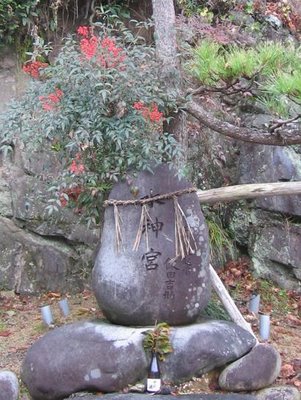
Stone Memorial for the God of Water

winter in town –
the stone memorial of the
God of Water


Gabi Greve, Katsuyama 2005


There are many rituals and ceremonies concerning WATER in Japan. Here is a list of some I have covered elsewhere:

First Water, "young water" (wakamizu)
Including more kigo of this ceremony.
First water drawing is most important for the tea ceremony and some temple and shrine rituals.

Drawing Sacred Well Water,
O-Mizutori, Omizutori, お水取り

Nara

Suijinsama 水神様 <> The Gods of the Four Elements, the Water God

..... SUIJIN God of Water

Daigosui 醍醐水 Water from the temple Daigoji and
Gosan Ryori
, gosan ryoori 醐山料理, prepared with this water.


Akai no Mizu 閼伽井 / Kannon Bosatsu Water 観音水
From temple Iwakura Daiun-ji, Kyoto. For healing mental illness.


Other items concerning WATER

Kappa 河童 <> The Water Goblin

Kettle, tea kettle (kama, chagama, tetsubin)
Water kettle, water pot.

Rain Rituals (amagoi) Rain Dance, Rain Prayer, Regenzauber

Sound of Water (mizu no oto) Japan
a famous haiku phrase

Sprinkling Water (uchimizu, Japan)

Suiteki 水滴 water drippers for calligraphy

Taki 滝 <> Waterfalls named Daruma
..... TAKI ... Waterfalls and Fudo Myo-o

..... Water in various kigo
including: clear water in summer (shimizu), water birds, water lily, water melon, waterfall, dripping water and many more

Water Shortage (Tropics)

::::::::::::::::::::::::::::::::::::::::::::::::::::::::::::::::::::::::::::::::::::::::::::::::::::

quote
The Blessings of Water
IWAI Hiromi Professor of Folklore,
Tezukayama University

Mikunari God, Kawakami God

Water is a blessing from another world. It flows down the sides of mountains, through villages, and finally into the sea. Because water is indispensable to villagers farming the land, since ancient times, Japanese have prayed to gods to ensure water for their villages.

Mikumari, one of these gods, presides over running water. The "kumari" portion of the name comes from the word "kubari", which means distribution.

The god's name is therefore often found in the names of shrines dedicated to water gods and located at the sources of rivers and watersheds. In terms of folklore, the Kojiki states that the gods Ame-no-mikumari and Kuni-no-mikumari appeared as the children of two other gods, Haya-akitsu-hiko and Haya-akitsu-hime. The Engi Shiki mentions four "mikumari" shrines"Katsuragi Mikumari Shrine in Katsuragi-gun, Yoshino Mikumari Shrine in Yoshino-gun, Uda Mikumari Shrine in Uda-gun, and Tsuge Mikumari Shrine in Yamabe-gun-in Yamato-no-kuni (today's Nara Prefecture) along with Take Mikumari Shrine in Ishikawa-gun in Kawachi-no-kuni (Osaka Prefecture) and Ame-no-mikumari Toyoura-no-mikoto Shrine in Sumiyoshi-gun, Settsu-no-kuni (also in Osaka Prefecture). As sacred distributors of water, the mikumari were also often the object of prayers for rain. The Shoku-nihongi tells that in April of 698, the second year of Emperor Monmu, a horse was presented to the god Yoshino Mikumari as a rain offering.

The god Kawakami also presides over water. The Engi Shiki mentions the god Niu-Kawakami in Yamato-no-kuni. Today's Niu Kawakami Shrine is made up of three sites, Kami, Naka, and Shimo, wherein "kami" refers to the top, "naka" to the middle, and "shimo" to the bottom. The Kami Shrine mainly deifies Takaokami-no-kami, while Naka Shrine deifies Mitsuhahime-no-kami and Shimo Shrine Kuraokami-no-kami. These kami (gods) all preside over water and have been worshiped as rain gods since ancient times.

In Kyoto, Kibune Shrine deifies Takaokami-no-kami, who is worshiped as a rain god. It is described in the Shoku-nihongi, the Nihon-koki, the Shoku-nihon-kok , the Montoku-tenno Jitsuroku, and the Sandai Jitsuroku that from 765, the seventh year of Tempyohoji, people prayed almost every year to Niu-Kawakami and Kibune for rain. They are said to have offered a black horse when they wanted the rains to start and a white horse when they wanted the rains to end because it was believed that the spirit of the gods descend to earth on a horse. Black is the color for casting a rain spell as it symbolizes dark clouds bringing rain. In contrast, white is the symbol of the bright sun. These prayers were held as national events.

Water for Purification

Water flowing down from mountains empties into the sea. Because the ancient Japanese believed that the sea was another world where gods lived, touching seawater was called "misogi", or purification of the self. In preparation for welcoming the spirit of the gods and holding a feast, people had to avoid impurity and perform monoimi (abstaining from food and drink for a period in order to purify oneself.) while waiting for the day to arrive; misogi was performed for this purpose.

People believed that seawater, a way to connect with that other world, was a strong purifier, so misogi originally involved bathing in seawater. People in Kyushu have long practiced customs known as "paddling seawater," "kicking seawater" and "taking seawater." And in a fishing village in Shima, Mie Prefecture, the custom is for villagers to bathe together in the sea on New Year's Eve. It is said that bathing in the sea around the festival days of Sumiyoshi Shrine in June has the miraculous effect of prolonging life; this activity has been named "Sumiyoshi-no-o'yu" (Sumiyoshi Bath).
And even those from mountain villages who go all the way down to the beach to do misogi have names for this journey: "hama-ori" (going down to the beach) and "hama-iki" (going to the beach). Today, small mounds of salt are sometimes seen in public locations, a reminder of misogi with seawater.

The Engi Shiki tells us that when people went to worship at Ise Shrine, they performed their misogi at landings along the Miyagawa River, the largest river in Iga-no-kuni (Mie Prefecture). During the Edo period, Many people traveled to the shrine by crossing the Miyagawa River by boat. Reaching the other side of the river meant entering the precincts of the gods, so landings on the shrine side of the river with such names as "Sakura-no-watashi (Cherry Tree Landing)," "Yanagi-no-watashi (Willow Landing)," "Iso-no-watashi (Seashore Landing)," and "Kamijo-no-watashi (Kamijo Landing)" were designated sacred places in which people could perform misogi before they actually entered the precincts of the gods. Fishing for ayu (sweetfish) in the sacred Miyagawa River was prohibited until the Edo period because the fish were used as offerings during shrine services.

In areas far from the sea, people began to perform misogi in rivers, believing that seawater entered the rivers during high tides. Thus the act of misogi spread inland. People also grew to believe that wells led to the other world, so well water also came to be used as water for misogi.
source : www.kippo.or.jp / Iwai Hiromi


*****************************
HAIKU


WATER just like that (mizu, sui  ) is not a kigo in Japan but a nonseasonal topic.

But since water is a constant necessity throughout the year, there are many detailed phenomenon used as kigo for it. And in olden times with no tabwater, this comodity was really important for the continuation of life.


New Year decoration of a rural well in Japan
© Gabi Greve, January 2007


WATER, a list of related KIGO


MY ONSEN 温泉 . おんせん Hot Springs of Japan


*****************************
Related words

***** WKD : Drinks in the seasons - SAIJIKI


[ . BACK to DARUMA MUSEUM TOP . ]
[ . BACK to WORLDKIGO . TOP . ]
:::::::::::::::::::::::::::::::::::::::::::::::::::::::::::::::::::::::::::::::::::::::::::::::::::::

2/14/2008

Ningyooyaki figure waffles

[ . BACK to WORLDKIGO TOP . ]
::::::::::::::::::::::::::::::::::::::::::::::::::::::::::::::::::::::::::::::::::::::::::::::::::::

Figure waffles (ningyooyaki 人形焼)

***** Location: Japan
***** Season:
***** Category: Humanity


*****************************
Explanation

ningyoyaki, ningyooyaki, ningyoo yaki, ningyoo-yaki 

waffles in the form of small figures
Ningyo-yaki
are small snack cakes, made from cooking batter of flour, eggs and sugar in an iron mold. They are sold both with and without sweet bean paste (anko).
Many come in the form of the seven gods of good luck (shichifukujin 七福神) or the great lantern at the Kaminarimon gate of Asakusa temple.

CLICK for more photos
. . . CLICK here for more Photos !

They come from the Ningyocho-District of Edo.
人形町通り
This main street has many restaurants, teas shops and Japanese style bars (izakaya).
The confectionary stores sell the famous NINGYOYAKI from the area.
This sweet is also sold at Asakusa.


The people of Edo believed in the worship of the seven gods of good luck. Each shrine is located in the Ningyocho district. It takes about an hour to stroll around all the shrines. Each god has its own luck you can receive by visiting the shrine.


. WASHOKU
Benten, Benzaiten Ningyoyaki 弁財天
 
One of the Seven Gods of Good Luck


:::::::::::::::::::::::::::::::::::::::::::::::::::::::::::::::::::::::::::::::::::::::::::::::::::


A special one is the TAIYAKI
sea bream waffles  鯛焼き taiyaki
kigo for all winter


WASHOKU : Asakusa


:::::::::::::::::::::::::::::::::::::::::::::::::::::::::::::::::::::::::::::::::::::::::::::::::::::


Himeji 姫路名物『お城やき』O-Shiro-Yaki
Castle waffles


*****************************
Worldwide use

Figuren-Waffeln

*****************************
Things found on the way


Daruma San waffles だるま人形焼
There is a special waffle iron to make them !


. Daruma Yaki だるま焼き  Taiyaki Daruma たい焼き達磨


*****************************
HAIKU and SENRYU


新緑に人形焼の香り立つ
shinryoku ni ningyooyaki no kaori tatsu 

among the fresh green
there is the fragrance of
figure waffles

Akane あかね
source : あかね


*****************************
Related words

***** . Shichi-Fukujin 七福神 Seven Gods of Good Luck .

***** WAGASHI ... Sweets SAIJIKI


:::::::::::::::::::::::::::::::::::::::::::::::::::::::::::::::::::::::::::::::::::::::::::::::::::::::::::::::::::::::::::


. Famous Places and Powerspots of Edo .


source : ゆたほん


Ningyoochoo, Ningyōchō 人形町 Ningyocho, Ningyo-Cho
"Doll district", "Doll-maker distsrict"

. 中央区 Chuo Ward "Central Ward" .


- quote -
Ningyocho is sophisticated district of old downtown Edo with history and tradition, located in central Tokyo’s Nihonbashi. This neighborhood with a flair of old downtown Edo is home of Amazake Yokocho street, and is popular among people young and old.


Mechanical figurine clock towers: Symbols of Ningyocho
There are two clock towers on opposite sides of Ningyocho-dori Street. They feature themes of hikeshi firefighters and rakugo comic storytelling.
On the every hour, from 11 am to 7 pm, their figurines move to entertain tourists and others passing by.

The area holds many traditional crafts shops dating back to the Edo period and tasty long-established eateries. One can experience Japan’s unique feel of the seasons that it is becoming harder to find today through seasonal events such as the Flower Festival, chinaware market, and doll market.
Ningyocho gets its name from being a town of dolls (ningyo). In the past, it was a lively town of those involved with dolls, such as doll makers, puppeteers, and puppet theaters. About 400 years ago in Edo era, when the Shogun Ieyasu Tokugawa ruled, Ningyocho was vibrant as the birthplace of Edo Kabuki theater. Puppet shows for the common people too developed into affordable entertainment, gaining great popularity.
The very famous Suitengu Shrine that is said to bring fortune for safe childbirth and childrearing can also be found in Ningyocho. On Inu no Hi* that is said to be a fortuitous day for safe childbirth, many pregnant women and their families come to worship at the shrine.
Ningyocho
is even today colored with the traditions and customs of old downtown and features sophisticated customs. It is popular as a town of tradition, and is lively with visitors of all kinds. Long-standing restaurants, traditional craft shops that exhibit skills passed down from the past, Japanese sweets shops indispensable for the tea ceremony, and more can be found here.
*Inu no Hi, literally “dog day”,
is day in the oriental zodiac that comes once every 12 days. From ages past, the first “dog day” of the fifth month of pregnancy has been a time when pregnant women traditionally wrap their belly in cloth and pray for safe childbirth. As dogs are said to have an easy time giving birth, this is a good time to pray for safe childbirth.
- source : ningyocho.or.jp/english -


. shinise 老舗 a long-established store in Edo .
Ningyoyaki Honpo Itakuraya (Ningyoyaki: small buns with the faces of deities)
Ningyocho Imahan (sukiyaki and shabu-shabu)
Ningyocho Shinodazushi Sohonten (sushi)

- reference : edo ningyocho -

.......................................................................

. Motoosakachoo 元大阪町 Moto-Osaka district .
Chuo ward, Nihonbashi, Ningyocho first sub-district

:::::::::::::::::::::::::::::::::::::::::::::::::::::::::::::::::::::::::::::::::::::::::::::::::::::::::::::::::::::::::::


. manekineko 招き猫 beckoning cat .

:::::::::::::::::::::::::::::::::::::::::::::::::::::::::::::::::::::::::::::::::::::::::::::::::::::::::::::::::::::::::::


. Food and Drink with Kappa 河童 .

:::::::::::::::::::::::::::::::::::::::::::::::::::::::::::::::::::::::::::::::::::::::::::::::::::::::::::::::::::::::::::

[ . BACK to DARUMA MUSEUM TOP . ]
[ . BACK to WORLDKIGO . TOP . ]
#ningyocho #motoosakacho #osakacho #ningyoyaki
:::::::::::::::::::::::::::::::::::::::::::::::::::::::::::::::::::::::::::::::::::::::::::::::::::::::::::::::::::::::::::