::::::::::::::::::::::::::::::::::::::::::::::::::::::::::::::::::::::::::::::::::::::::::::::::::::
Trout (ayu and masu)
***** Location: Japan
***** Season: Various, see SEAFOOD SAIJIKI
***** Category: Humanity
*****************************
Explanation
Here we are concerned with the various types of trout, Forelle.
There is a bit of confusion with the vocabulary. Sometimes different names are given.
Trout is the common name given to a number of species of freshwater fish belonging to the Salmonidae family.
Fish referred to as trout include:
Genus Salmo
Genus Oncorhynchus
Genus Salvelinus (Char)
. . . . . check more of the latin names here
© More in the WIKIPEDIA !
The ayu (アユ, 鮎),(香魚) or sweetfish,
Plecoglossus altivelis, is an amphidromous fish, the only species in the genus Plecoglossus and in family Plecoglossidae. It is a relative of the smelts and is placed in the order Osmeriformes. Native to the Palearctic ecozone, it occurs in rivers, lakes, and coastal waters of western Hokkaidō in Japan southward to the Korean Peninsula, China, and Taiwan.
Ryūkyū ayu (Plecoglossus altivelis ryukyuensis) is a subspecies of ayu, endemic to the Ryukyu Islands:
© More in the WIKIPEDIA !
:::::::::::::::::::::::::::::::::::::::::::::::::::::::::::::::::::::::::::::::::::::::::::::::::::
ayu 鮎 trout, sweetfish
Plecoglossus altivelia
annually coming fish, nengyo 年魚
fragrant fish, koogyo 香魚 (best when roasted near a fire)
鮎漁解禁(あゆりょうかいきん)、
ayu zushi, ayu sushi 鮎鮨(あゆずし)
ayu namasu, ayu in namasu dressing 鮎膾(あゆなます)、
鮎魚田(あゆぎょでん)、香魚(こうぎょ)、鮎狩(あゆがり)、
鮎掛(あゆかけ)、鮎の宿(あゆのやど)、
鮎の里(あゆのさと)、鮎生簀(あゆいけす)、
囮鮎(おとりあゆ)、鮎籠(あゆかご)、鮎漁(あゆりょう)、
鮎時(あゆどき)
. . . CLICK here for Photos !
kigo for all summer
Süßwasserlachs ?Bachforelle
trout coming downstream, descending sweetfish, ochi-ayu 落鮎
Plecoglossus altivelis
..... kudari-ayu 下り鮎
autumn sweetfish, aki no ayu 秋の鮎
rusty sweetfish, sabi-ayu 錆鮎
muted sweetfish, bitter sweetfish, shibu-ayu 渋鮎
kigo for all autumn
tooshi-ayu 通し鮎 (とおしあゆ) trout surviving (this year)
..... tomari-ayu 止り鮎(とまりあゆ)
They are rather strong and can survive the winter season.
kigo for all winter
:::::::::::::::::::::::::::::::::::::::::::::::::::::::::::::::::::::::::::::::::::::::::::::::::::::
Iwana 岩魚 (いわな) bull trout whitespotted char
Salvelinus leucomaenis
Japanese trout in the genus of Salvelinus.
kagyo 嘉魚(かぎょ)
fishing for bull trout, iwana tsuri 岩魚釣(いわなつり)
hunting for bull trout, iwanagari 岩魚狩(いわながり)
. . . CLICK here for Photos : whitespotted char !
kigo for all summer
.................................................................................
kigo for late spring
masu, 鱒 (ます) trout
Salmo milktschitsch
sometimes translated as "salmon"
benimasu 紅鱒(べにます)? roter Lachs ? benizake
umimasu, Ocean trout 海鱒(うみます)
Karafuto masu 樺太鱒(からふとます)pink salmon、humpback salmon
Oncorhynchus gorbuscha
. . . . . another name is
"camel trout" rakuda masu 駱駝鱒(らくだます)
Buckellachs, Lachsforelle; rosa Lachs
"real trout", honmasu 本鱒(ほんます)
Oncorhynchus rhodurus
"cherry trout", sakuramasu 桜鱒(さくらます), Masou trout
Oncorhynchus masou
. . . CLICK here for Photos !
masunosuke ますのすけ 鱒之介
chinook [spring/king] salmon
seppari masu 背張鱒(せっぱります)
fishing for trout, masutsuri 鱒釣り(ますつり)
trout coming upstream, masu noboru鱒上る(ますのぼる)
.................................................................................
kigo for all summer
himemasu, red salmon 姫ます, Kokanee
Oncorhynchus nerka nerka
nijimasu 虹ます a rainbow trout, Regenbogenforelle
Oncorhynchus mykiss (Salmo gairdneri)
kawamasu 川鱒 (かわます) "river trout"
Salvelinus fontinalis
:::::::::::::::::::::::::::::::::::::::::::::::::::::::::::::::::::::::::::::::::::::::::::::::::::::
kigo for all autumn
amago trout あまご
amenouo 江鮭 あめのうお
amenouo 鯇魚(あめのうお)
amemasu あめ鱒(あめます)/ 雨鱒 "rain trout"
Oncorhynchus masou ishikawae
. . . CLICK here for Photos !
. Dishes with amago trout
steelhead trout, a kind of salmon
. . . CLICK here for Photos !
:::::::::::::::::::::::::::::::::::::::::::::::::::::::::::::::::::::::::::::::::::::::::::::::::::::
- quote -
AMEMASU アメマス / 雨鱒
TRANSLATION: white-spotted char; literally “rain trout”
HABITAT: cold streams and lakes, occasionally seagoing
DIET: carnivorous, ranging from small fish and plankton up to and including large boats
APPEARANCE:
Amemasu is the Japanese name for the white-spotted char (Salvelinus leucomaenis leucomaenis), a species of trout which is found in Northeast Asia. They are a popular target of game fishing and are also raised in fisheries.
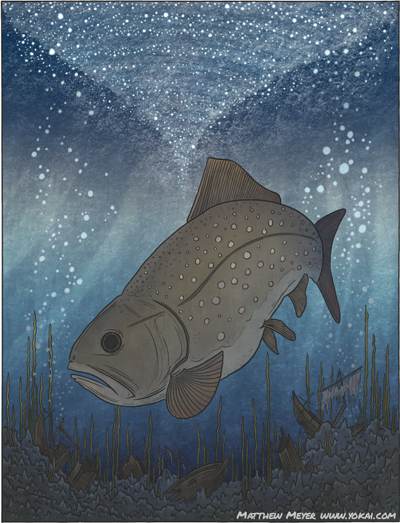
BEHAVIOR:
Amemasu spend most of their lives in the water, away from humans. They are found mostly in rivers and streams, but seagoing varieties exist as well. They are more common in Hokkaido, the northern parts of Honshu, and along the Sea of Japan—however legends of amemasu are occasionally found in the southern parts of Japan as well. They feed on whatever they can eat—from plankton to insects, to fish and any other aquatic lifeforms they can fit into their mouths. Yōkai amemasu can grow to colossal sizes, sometimes spanning an entire lake from head to tail. These giant amemasu also occasionally thrash and sink ships, devouring any poor souls who happened to be on the ship. In Ainu folklore, the wild thrashing of giant amemasu is believed to be what causes earthquakes—much like giant catfish are thought to cause earthquakes in the rest of Japan.
INTERACTIONS:
Amemasu can transform into human shape and walk about on land. They usually take the form of young, beautiful women in order to seduce young men. Shape-changed amemasu can be identified by their skin, which feels cold and clammy like that of a fish.
LEGENDS:
A number of lakes in Hokkaido are believed to be the home of giant amemasu. According to Ainu folklore, these amemasu are thought to be the guardian deities of their respective lakes. Lake Mashū is home to an amemasu the size of a whale. Lake Shikotsu contains an amemasu so large that its head touches one end of the lake and its tail touches the other.
- - - A legend from Minabe,
Wakayama Prefecture tells of a mysterious whirlpool that appeared in a deep pond. A giant amemasu lived in the pond. Every spring, she would emerge from the pond in the form of a beautiful woman. For two or three days she would catch young men and take them away—where to nobody knows, but they were never seen again. The only way to know that it was a fish and not a woman was from her cold, clammy skin. One day, a cormorant dove into the pond to go hunting. The giant amemasu swallowed the bird in a single gulp. However, after a short time, the amemasu’s body floated up to the surface of the pond, dead. The cormorant burst out of its stomach. A shrine was built at that spot to honor Konpira-san, which still stands today.
- source : yokai.com/amemasu -
コサメ(アメマス)kosame = amemasu from Wakayama
In Akita, there is a place called
ame masu otoshi アメ鱒落し
A hawk who lived on top of the mountain stood on the rocks of the lakeside, looking out for trout. When he wanted to pull one out, the trout was fighting vigorously and eventually both animals died.
仙北市 / 田沢湖・西木村西明寺
. - yookai, yōkai 妖怪 Yokai monsters - .
- Introduction -
:::::::::::::::::::::::::::::::::::::::::::::::::::::::::::::::::::::::::::::::::::::::::::::::::::::
Yamame やまめ (山女) landlocked salmon
Oncorhynchus masou
Bachforelle
Yamame variety, trout-salmon, yukishiro yamame
雪代山女 (ゆきしろやまめ)
yukishiro iwana 雪代岩魚(ゆきしろいわな)
yukishiro masu 雪代鱒(ゆきしろます)
kigo for mid-spring
konoha yamame 木の葉山女 (このはやまめ)
landlocked salmon "among fallen leaves"
kigo for late autumn
::::::::::::::::::::::::::::::::::::::::::::::::::::::::::::::::::::::::::::::::::::::::::::::::::::
ayumodoki 鮎もどき (あゆもどき) Kissing Loach
"looks like a trout"
..... 鮎擬(あゆもどき)
Leptobotia curta
kigo for all summer
. . . CLICK here for Photos !
*****************************
Worldwide use
Die Bachforelle (frz. truite rivière – it. trota ruscello) ist zweifelsohne die edelste ...
Bei der Meerforelle – frz. truite de mer – handelt es sich um die Wanderform, die sich aus standorttreuen Bachforellenbeständen entwickelt.
Seeforelle ...
Bei Bach-, See- und Meerforellen handelt es sich somit nicht um verschiedene Arten, sondern alle drei gehören derselben Familie an. Einzig die verschiedenen Lebensräme und -formen bedingen die Unterschiede in Aussehen, Wachstum und Verhalten.
Ihren Namen erhielt die Regenbogenforelle (frz. truite arc-en-ciel – it. trota arcobaleno) aufgrund des in allen Regenbogenfarben schillernden, breiten, rötlichen Seitenbandes.
Die Regenbogenforelle ist eine Kreuzung einer Wanderform und einer reinen Süßwasserform, unserer Bachforelle vergleichbar.
Die Lachsforelle ist weder eine Unterart der Familie der Forellen noch – wie der Name vermuten lassen könnte – eine Kreuzung zwischen Forelle und Lachs. Lachsforellen sind schlichtweg große Regenbogenforellen ...
source: www.aalfred.de
:::::::::::::::::::::::::::::::::::::::::::::::::::::::::::::::::::::::::::::::::::::::::::::::::::::
Der Unterschied zwischen Bach- und Regenbogenforelle ist folgender:
Die Bachforelle ist einheimisch und die Regenbogenforelle vor ungefaehr zweihundert Jahren aus Amerika zu uns gekommen. Bachforellen, die uebrigens nicht in einem Bach leben muessen, sondern auf sehr sauberes und sauerstoffreiches Wasser angewiesen sind, haben an den Flanken rote Punkte und je nach Untergrund sind sie falb, braun oder dunkelgrau. Regenbogenforellen werden haeufiger angeboten, da sie nicht ganz so anspruchsvoll an die Wasserqualitaet sind und schnelleren Wuchs haben. Man erkennt sie, wie der Name schon ahnen laesst, an ihrer schillernden Zeichnung, die stark an einen Regenbogen erinnert.
source: www.asg1960ev.de
Lachsforellen sind Regenbogenforellen aus Fischzuchten, das Fleich meist rosa oder rot.
*****************************
Things found on the way
ayu uranai 鮎占い divination with trout
The Chinese character for AYU 鮎 consists of fish 魚 in the left side
and uranai 占 divination on the right side.
So there is no wonder we also have a ritual of divination with this fish!
At the gorge Ootaki Kyoo 大滝峡、ayu uranai shinji 鮎占神事
onbe matsuri おんべ祭り Onbe Festival

source : kirari1000
At Mito Shrine 水戸神社, Ise Shima, Taiki village 大紀町
On the first Sunday in July.
12 elected people throw 12 trout over the small river into a round rock cavity of about 50 cm, one trout for each month to divine the outcome of year. They stand on a rock about 7 meter high above the cavity.
If they hit it straight, Great Luck and a flag is waved.
If they do not hit, it is still Middle Good Luck 中吉 and nothing bad should happen.
Of course a lot of grilled trout is also served at this festival.
:::::::::::::::::::::::::::::::::::::::::::::::::::::::::::::::::::::::::::::::::::::::::::::::::::::::
ayu no michi 鮎の道 road to carry ayu
also called Tsukui Ookan 津久井往還 Road of Tsukui, a town in the North-West of Kanagawa prefecture.

Trout that were fished in Kutsui had to be transported to Edo for consumption as fast as possible. They were carried to the tea shop Sangenjaya 三軒茶屋 in Setagaya 世田谷.
. Sangenjaya 三軒茶屋 Sangen-jaya, "three tea stalls" .
The fish were put in buckets and the carriers stopped ever so often to put fresh water into the bucket to keep the fish happy and alive.
There is also a "Trout Road" near Hachioji into Edo.
:::::::::::::::::::::::::::::::::::::::::::::::::::::::::::::::::::::::::::::::::::::::::::::::::::::::
japanesefood.about.com : recipes with TROUT
*****************************
HAIKU

source : itoyo/basho
鮎の子の白魚送る別れ哉
ayu no ko no shirauo okuru wakare kana
young ayu sweetfish
are seeing off the whitefish
and say good bye . . .
Tr. Gabi Greve
Written in 1689 元禄2年3月.
The whitefish are the first to go upstream to spawn, the ayu follow them one month later.
Basho and Sora are ready to depart for "Oku no Hosomichi" and he has to leave his young disciples (ayu no ko) behind at Senju.
This hokku has the cut marker KANA at the end of line 3.
Oku no Hosomichi
- - - Station 2 - Departure at Senju 千住 - 旅立 - - -
. Matsuo Basho 松尾芭蕉 - Archives of the WKD .
:::::::::::::::::::::::::::::::::::::::::::::::::::::::::::::::::::::::::::::::::::::::::::::::::::::::
焼鮎の膳より吹かれ箸袋
blown from the tray
with grilled sweetfish -
paperbag for chopsticks
Katsura Nobuko
WASHOKU
Grilled trout from Nara prefecture
*****************************
Related words
WASHOKU : FISH and SEAFOOD . SAIJIKI
***** WASHOKU : INGREDIENTS
***** . FISHING ... KIGO in all seasons
:::::::::::::::::::::::::::::::::::::::::::::::::::::::::::::::::::::::::::::::::::::::::::::::::::::::::::::::::::::::::::

歌川広重 Utagawa Hiroshige
- quote -
Ichiryusai HIROSHIGE (1797-1858) 広重一遊斎
Ai or ayu, river trout, Plecoglossus altivelis.
oem by Haruzono Shizuo. From the first set of fish prints published by Eijudo, c 1832-4. This first series was issued privately for a poetry group ( probably the Shingyoku Circle ) with judges’ names and extra poems. These prints are of the utmost rarity as probably only enough for the Circle were printed and they never come onto the market. Due to their popularity this first series was published commercially and a second set was commissioned. The most sought after print in the series and probably the first to be designed.
- source : japaneseprints-london.com -
:::::::::::::::::::::::::::::::::::::::::::::::::::::::::::::::::::::::::::::::::::::::::::::::::::::::::::::::::::::::::::
[ . BACK to DARUMA MUSEUM TOP . ]
[ . BACK to WORLDKIGO . TOP . ]
:::::::::::::::::::::::::::::::::::::::::::::::::::::::::::::::::::::::::::::::::::::::::::::::::::::::::::::::::::::::::::


11 comments:
鮎は外国にも居るんですね?
Thank you for interest informations.
sakuo.
cool green pools
brook trout rising for
brown hornbergs
bob
Matsuo Basho
又やたぐひ長良の川の鮎膾
mata ya tagui Nagara no kawa no ayu namasu
once again - this rare
pickled sweetfish
from river Nagaragawa
Tr. Gabi Greve
The cormorants from Nagaragawa fish for ayu sweetfish, and the humans eat them afterwards.
Matsuo Basho
鮎の子の白魚送る別れ哉
ayu no ko no / shirauo okuru / wakare kana
uranai 占い fortune telling, divination
The people of Edo were very fond of fortune telling of all kinds.
.
Legend from Kanagawa
.......................................................................
津久井郡 Tsukui district
Once two brothers were thowing their fishing nets out along the river of 三沢村 Misawa village. They caught a lot of ayu 鮎 trout. To make sure the Tengu would not be jealous of their catch, they opened three fish, cleaned them and put them on the lid of the fish trap.
Once the Tengu was not pleased and a 火の玉 huge ball of fire came down on their boat. They were afraid and rushed home.
But this was, most probably, not a Tengu but a
. kawauso 獺魚 / カワウソ river otter .
.
Legends about yamame
秩父郡 Chichibu district 両神村 Ryokami village
Someone went to the river to put out his net for yamame ヤマメ salmon and got his net all full in no time. When he wanted to lift the full net out of the river, it was all empty.
The fish he had caught before that were also gone from his basket. He had been fishing very close to a place sacred to Yamanokami. He became afraid, hurried home and had to stay in bed for many days.
.
and 14 ヤマメ more to explore
31 山女
.
https://japanshrinestemples.blogspot.com/2019/02/yamanokami-regional-26-saga-saitama.html
.
- Contribution from Larry Bole, Facebook:
ayu noboru kawa chichi no haha no kawa
river of 'ayu' returning
river of my father
river of my mother
-- Momoko Kuroda, tran. Abigail Friedman
hikari au ikesu no yo no otori ayu
meeting the light
of the restaurant fishtank's night
the alluring 'ayu'
-- Momoko Kuroda, tran. Higginson
koe araba ayu mo naku ran Ukai-bune
Had they a voice, ayu would cry
At sight of the cormorant boat.
-- Etsujin, tran. Asataro Miyamori
tobu ayu no soko ni kumo yuku nagare kana
A trout leaps;
Clouds are moving
In the bed of the stream.
-- Onitsura, tran. Blyth
hitomure no ayu me wo suginu mizu no iro
A school of trout
Passed by:
The color of the water!
-- Onitsura, tran. Blyth
furusato wa yoshi yuuzuki to ayu no ka to
my hometown's
just fine -- the evening moon
the fragrance of sweetfish
-- Katsura Nobuko, tran. from U. of Virginia Saijiki
.
Legends about ayu trout sweetfish
Aichi 愛知県 .....
新城市 Shinshiro city 長篠村 Nagashina village
. ryuuguu 竜宮と伝説 Ryugu Legends about the Dragon Palace .
At the river 寒渓川 Kankeigawa is an access to the Dragon Palace.
The master of this 川淵 riverside is an eel.
Once or twice a year it hunts for ayu 鮎 sweetfish (trout) and shows his features on the water surface. It stail is said to be in the form of a handfan.
.
https://japanshrinestemples.blogspot.com/2019/06/mizunokami-unagi-legends.html
.
Iwana legend from 岐阜県 Gifu 高山市 Takayama city 上宝町 Kamitakara town
.
iwana イワナ / 岩魚 bull trout
There is a river pool with a strong whirlpool, where the great master of the iwana bull trout lives.
There was a beautiful girl in the village and a handsome young man came to visit her regulary. But the mother of the girl was suspicious of the young man and made him eat 麦の焼き餅 mochi grilled with barley straw. Then she put a thread in her needle for cotton work and stuck it into the man. When she followed the cotton thread, she saw a large bull trout trying to swim in great pain. The bull trout asked the mother to forgive it and disappeared.
.
https://edoflourishing.blogspot.com/2020/08/cotton-momen.html
.
Legend about ayu sweetfish from Miyagi, Motoyoshi town
.
Once a man was trying at night to catch ayu 鮎 sweetfish in the river between
清泉寺 the Temple Seisen-Ji and 浄福寺 the Temple Jofuku-Ji. when
he heard a sound like silk being torn off for more than 30 minutes.
It suddenly became light like the day and then dark again.
People thought it must be the spirits of the dead coming and going from the Temple.
.
https://gokurakuparadies.blogspot.com/2022/01/jofukuji-fudo-kagawa.html
.
Post a Comment